Geometry & SLAM
B-splines for Purely Vision-based Localization and Mapping on Non-holonomic Ground Vehicles
2021 IEEE International conference on robotics and automation (ICRA) · 2021
RESEARCH SUMMARY
This paper uses B-splines to incorporate smooth, non-holonomic vehicle motion into visual localization and mapping, refining trajectories within six-degree-of-freedom bundle adjustment.
Read the supporting paper ↗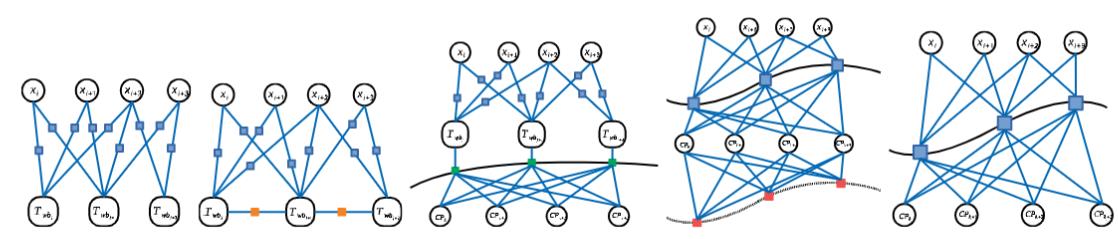
THE RESEARCH QUESTION
How can a vehicle's motion constraints improve visual SLAM?
A wheeled vehicle typically cannot move sideways freely. Treating each camera pose independently ignores this useful structure, particularly when visual measurements are weak or ambiguous. [Paper]
How the method works
- A continuous-time B-spline represents the vehicle trajectory instead of relying only on disconnected pose estimates.
- Hard or soft non-holonomic constraints are incorporated into bundle adjustment to model smooth vehicle motion more faithfully.
RESEARCH INTERPRETATION
What this contribution means
The method moves the motion prior into trajectory optimization itself. Simulation and real-data experiments examine how this improves robustness when visual evidence degrades.
This section explains the contribution in context. For experimental protocols, numerical results and comparisons, consult the original paper.
Scope and limitations
The prior is appropriate when the vehicle follows the assumed non-holonomic behavior. Significant sideways slip or motion outside that model can weaken its usefulness. [Paper]
Questions about this research
Is this a purely planar pose estimator?
The paper imposes vehicle trajectory constraints within a 6-DoF bundle-adjustment framework, rather than only solving independent planar pose pairs.
Read the original abstract
Purely vision-based localization and mapping is a cost-effective and thus attractive solution to localization and mapping on smart ground vehicles. However, the accuracy and especially robustness of vision-only solutions remain rivalled by more expensive, lidar-based multi-sensor alternatives. We show that a significant increase in robustness can be achieved if taking non-holonomic kinematic constraints on the vehicle motion into account. Rather than using approximate planar motion models or simple, pair-wise regularization terms, we demonstrate the use of B-splines for an exact imposition of smooth, non-holonomic trajectories inside the 6 DoF bundle adjustment. We introduce both hard and soft formulations and compare their computational efficiency and accuracy against traditional solutions. Through results on both simulated and real data, we demonstrate a significant improvement in robustness and accuracy in degrading visual conditions.
Original publication record ↗Sources, paper & code
Primary research sources support the summary above. Project resources provide demonstrations or implementations; Google Scholar is a bibliographic index.
- Primary sourcePublisher — original publication record ↗ieeexplore.ieee.org
- Primary sourceFull paper — author-hosted PDF ↗1fwang.github.io
- Metadata indexGoogle Scholar — bibliographic listing ↗scholar.google.com