Geometry & SLAM
Reliable frame-to-frame motion estimation for vehicle-mounted surround-view camera systems
2020 IEEE International conference on robotics and automation (ICRA) · 2020
RESEARCH SUMMARY
This paper improves frame-to-frame motion estimation for vehicle-mounted surround-view cameras, addressing planar-motion degeneracies with a geometric two-view optimization.
Read the supporting paper ↗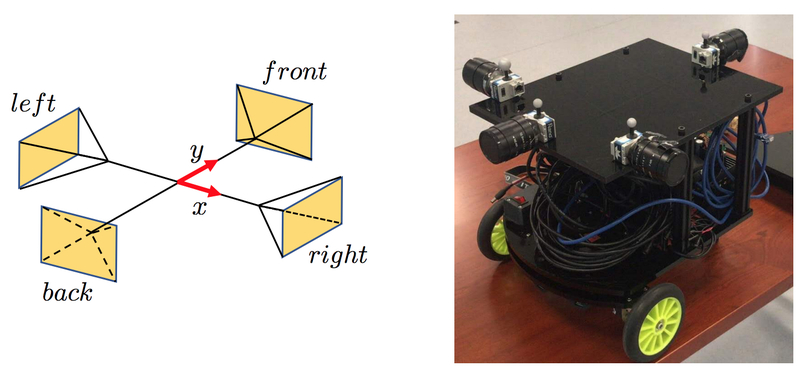
THE RESEARCH QUESTION
Why can constrained vehicle motion be difficult for surround-view odometry?
Known camera baselines do not remove every motion degeneracy. A vehicle's planar, non-holonomic movement can make some relative-pose configurations difficult to estimate reliably. [Paper]
How the method works
- The relative-motion formulation handles planar displacements encountered by vehicle-mounted surround-view camera systems.
- A two-view refinement minimizes a geometrically meaningful error without adding 3D scene-point optimization variables.
RESEARCH INTERPRETATION
What this contribution means
The work strengthens the initialization and local motion-estimation part of a SLAM pipeline. Avoiding point variables keeps the two-view problem focused on the relative motion itself.
This section explains the contribution in context. For experimental protocols, numerical results and comparisons, consult the original paper.
Scope and limitations
Frame-to-frame accuracy is distinct from long-term map consistency. Loop closure or trajectory-level optimization is still a separate part of a complete mapping system. [Paper]
Questions about this research
Does this method optimize a full 3D map for each frame pair?
Its two-view optimization avoids 3D point variables and focuses on a geometric error for relative motion.
Read the original abstract
Modern vehicles are often equipped with a surround-view multi-camera system. The current interest in autonomous driving invites the investigation of how to use such systems for a reliable estimation of relative vehicle displacement. Existing camera pose algorithms either work for a single camera, make overly simplified assumptions, are computationally expensive, or simply become degenerate under non-holonomic vehicle motion. In this paper, we introduce a new, reliable solution able to handle all kinds of relative displacements in the plane despite the possibly non-holonomic characteristics. We furthermore introduce a novel two-view optimization scheme which minimizes a geometrically relevant error without relying on 3D point related optimization variables. Our method leads to highly reliable and accurate frame-to-frame visual odometry with a full-size, vehicle-mounted surround-view camera system.
Original publication record ↗Sources, paper & code
Primary research sources support the summary above. Project resources provide demonstrations or implementations; Google Scholar is a bibliographic index.
- Primary sourcePublisher — original publication record ↗ieeexplore.ieee.org
- Primary sourceFull paper — author-hosted PDF ↗1fwang.github.io
- Metadata indexGoogle Scholar — bibliographic listing ↗scholar.google.com