Geometry & SLAM
Motion estimation of non-holonomic ground vehicles from a single feature correspondence measured over n views
Proceedings of the IEEE Conference on Computer Vision and Pattern Recognition · 2019
RESEARCH SUMMARY
This paper estimates non-holonomic ground-vehicle motion from one tracked feature across multiple views, using a constrained motion model to derive a compact polynomial solution.
Read the supporting paper ↗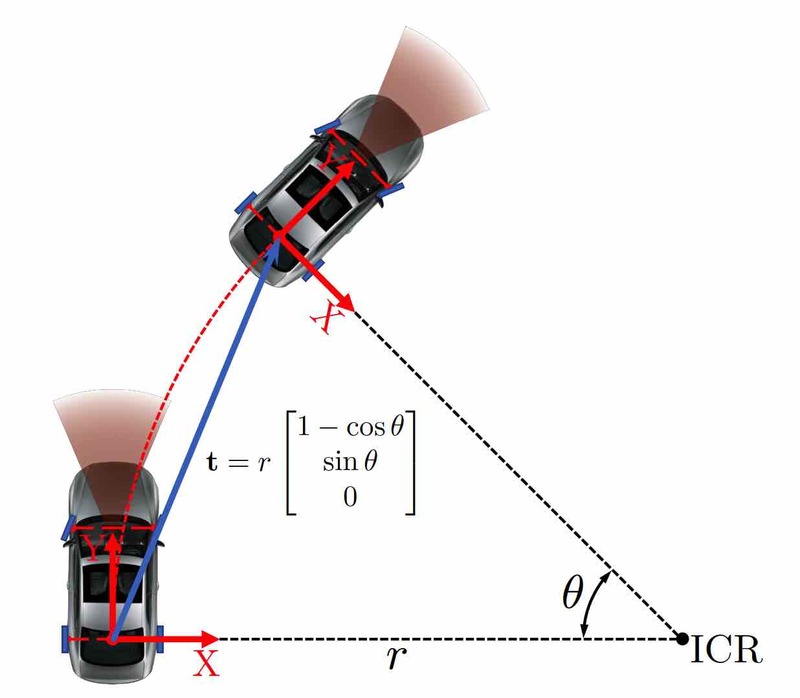
THE RESEARCH QUESTION
When can one feature provide enough information for vehicle motion estimation?
General camera motion usually requires several correspondences. A ground vehicle's motion constraints, combined with observations over more than two views, can supply additional structure that reduces the necessary visual input. [Paper]
How the method works
- The formulation assumes locally circular, constant-speed non-holonomic motion and follows a point or vertical-line feature over multiple views.
- Algebraic reductions yield a univariate polynomial for the motion-estimation problem.
RESEARCH INTERPRETATION
What this contribution means
The result shows how temporal observations and a strong physical motion prior can substitute for additional simultaneous features. The paper compares the method with a one-point, two-view alternative using simulated and real data.
This section explains the contribution in context. For experimental protocols, numerical results and comparisons, consult the original paper.
Scope and limitations
The single-feature result depends on the specified motion model and multi-view observations. It is not a general one-point solution for arbitrary 6-DoF camera motion. [Paper]
Questions about this research
Does one correspondence mean only two images are needed?
No. The contribution uses a feature observed across multiple views, together with the assumed ground-vehicle motion model.
Read the original abstract
The planar motion of ground vehicles is often non-holonomic, which enables a solution of the two-view relative pose problem from a single point feature correspondence. Man-made environments such as underground parking lots are however dominated by line features. Inspired by the planar tri-focal tensor and its ability to handle lines, we establish an n-linear constraint on the locally circular motion of non-holonomic vehicles able to handle an arbitrarily large and dense window of views. We prove that this stays a uni-variate problem under the assumption of locally constant vehicle speed, and it can transparently handle both point and vertical line correspondences. In particular, we prove that an application of Viete's formulas for extrapolating trigonometric functions of angle multiples and the Weierstrass substitution casts the problem as one that merely seeks the roots of a uni-variate polynomial. We present the complete theory of this novel solver, and test it on both simulated and real data. Our results prove that it successfully handles a variety of relevant scenarios, eventually outperforming the 1-point two-view solver.
Original publication record ↗Sources, paper & code
Primary research sources support the summary above. Project resources provide demonstrations or implementations; Google Scholar is a bibliographic index.
- Primary sourcePublisher — original publication record ↗openaccess.thecvf.com
- Primary sourceFull paper — author-hosted PDF ↗1fwang.github.io
- Metadata indexGoogle Scholar — bibliographic listing ↗scholar.google.com