Geometry & SLAM
TXR-SLAM System: Hilti SLAM Challenge 2023 Entry (Team “XR Penguin”–Vision/IMU-only track)
Technical report · Hilti SLAM Challenge 2023 · 2023
RESEARCH SUMMARY
TXR-SLAM is the XR Penguin team's vision/IMU-only entry to the Hilti SLAM Challenge 2023, combining multi-camera tracking, sliding-window optimization, loop closure and full trajectory refinement.
Read the supporting paper ↗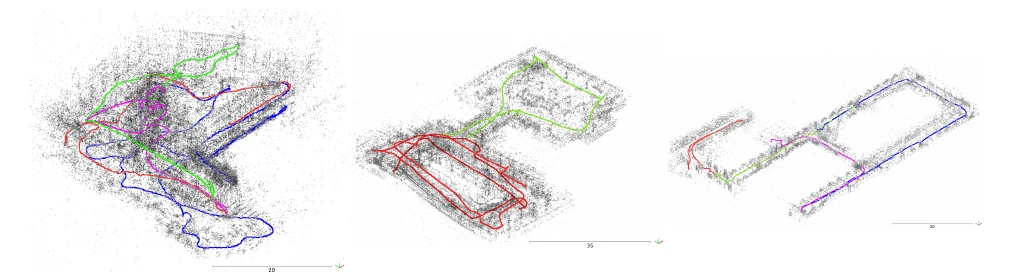
THE RESEARCH QUESTION
What does a complete multi-camera challenge SLAM system require?
Real sequences include dark images, dropped measurements, imperfect synchronization and limited overlap between sessions. Reliable mapping therefore depends on calibration, preprocessing and map management as well as pose estimation. [Paper]
How the method works
- Visual observations from multiple cameras and pre-integrated IMU measurements enter sliding-window bundle adjustment.
- Loop closure and automatic map merging connect revisited areas and multiple sessions. Full visual-inertial bundle adjustment refines the final result.
RESEARCH INTERPRETATION
What this contribution means
The report shows how system-level choices affect benchmark performance. It records difficult sequences and processing times, making it useful context for the multi-camera design subsequently described in MAVIS.
This section explains the contribution in context. For experimental protocols, numerical results and comparisons, consult the original paper.
Scope and limitations
The reported final trajectory is non-causal because global refinement uses later observations. Some sessions cannot be merged when overlap is insufficient. The report uses cameras and IMU, without LiDAR measurements. [Paper]
Questions about this research
Are the final TXR-SLAM results strictly online?
No. The report explicitly describes non-causal final refinement using full bundle adjustment and loop closure.
Sources, paper & code
Primary research sources support the summary above. Project resources provide demonstrations or implementations; Google Scholar is a bibliographic index.
- Primary sourceHilti Challenge — original technical report ↗hilti-challenge.com
- Metadata indexGoogle Scholar — bibliographic listing ↗scholar.google.com
Year refers to the challenge edition; Scholar does not list a publication date.