Geometry & SLAM
MAVIS: Multi-Camera Augmented Visual-Inertial SLAM using SE2(3) Based Exact IMU Pre-integration
ICRA 2024 · 2024
RESEARCH SUMMARY
MAVIS combines multiple cameras with an IMU for visual-inertial SLAM. Its exact SE₂(3)-based IMU pre-integration strengthens motion estimation during fast rotations and longer integration intervals.
Read the supporting paper ↗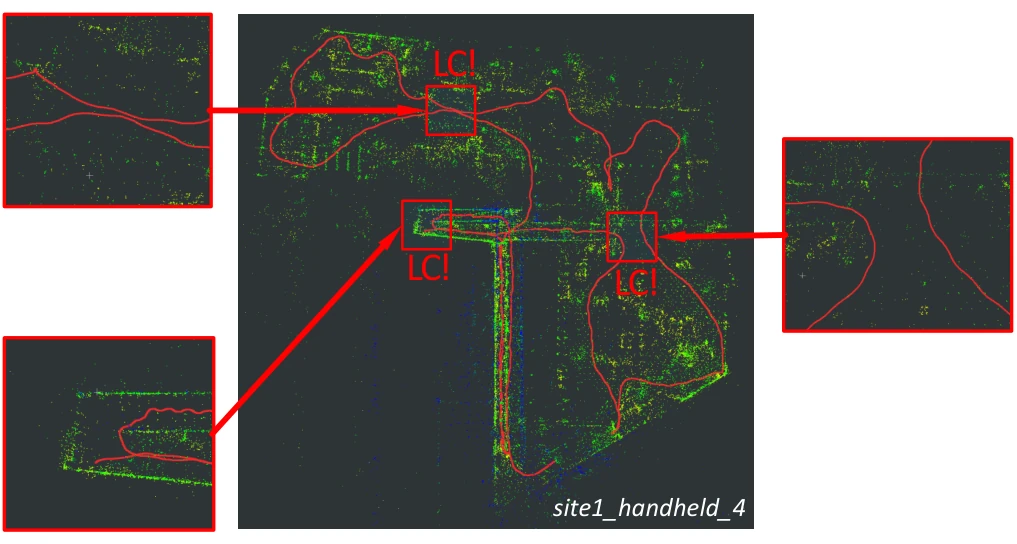
THE RESEARCH QUESTION
What changes when visual-inertial SLAM uses more than two cameras?
A multi-camera rig sees more of its surroundings, but exploiting that coverage requires tracking and optimization across partially overlapping views. Inertial integration accuracy also matters when visual updates are separated by fast motion or longer intervals. [Paper]
How the method works
- An SE₂(3)-based formulation provides exact IMU pre-integration and associated uncertainty propagation under the method's model.
- The front and back ends combine observations across cameras, with loop closure and multi-session mapping extending the system beyond local tracking.
RESEARCH INTERPRETATION
What this contribution means
MAVIS combines an inertial modeling contribution with a complete multi-camera SLAM system. Evaluations on EuRoC and Hilti data examine tracking and mapping performance; the linked implementation provides a practical starting point for understanding the system.
This section explains the contribution in context. For experimental protocols, numerical results and comparisons, consult the original paper.
Scope and limitations
Exact pre-integration describes the mathematical formulation, not error-free sensors or trajectories. Calibration, synchronization, visual coverage and inertial measurement quality still affect the result. [Paper]
Questions about this research
Is MAVIS a camera-only SLAM system?
No. It fuses multi-camera observations with inertial measurements.
Sources, paper & code
Primary research sources support the summary above. Project resources provide demonstrations or implementations; Google Scholar is a bibliographic index.
- Primary sourcearXiv — paper record and versions ↗arxiv.org
- Primary sourceFull paper — PDF ↗arxiv.org
- Research resourceCode — repository ↗github.com
- Metadata indexGoogle Scholar — bibliographic listing ↗scholar.google.com