Geometry & SLAM
Accurate calibration of multi-perspective cameras from a generalization of the hand-eye constraint
2022 IEEE International conference on robotics and automation (ICRA) · 2022
RESEARCH SUMMARY
This paper generalizes the hand–eye calibration constraint to multi-perspective camera systems, providing a closed-form route to calibrating camera rigs against an externally tracked reference.
Read the supporting paper ↗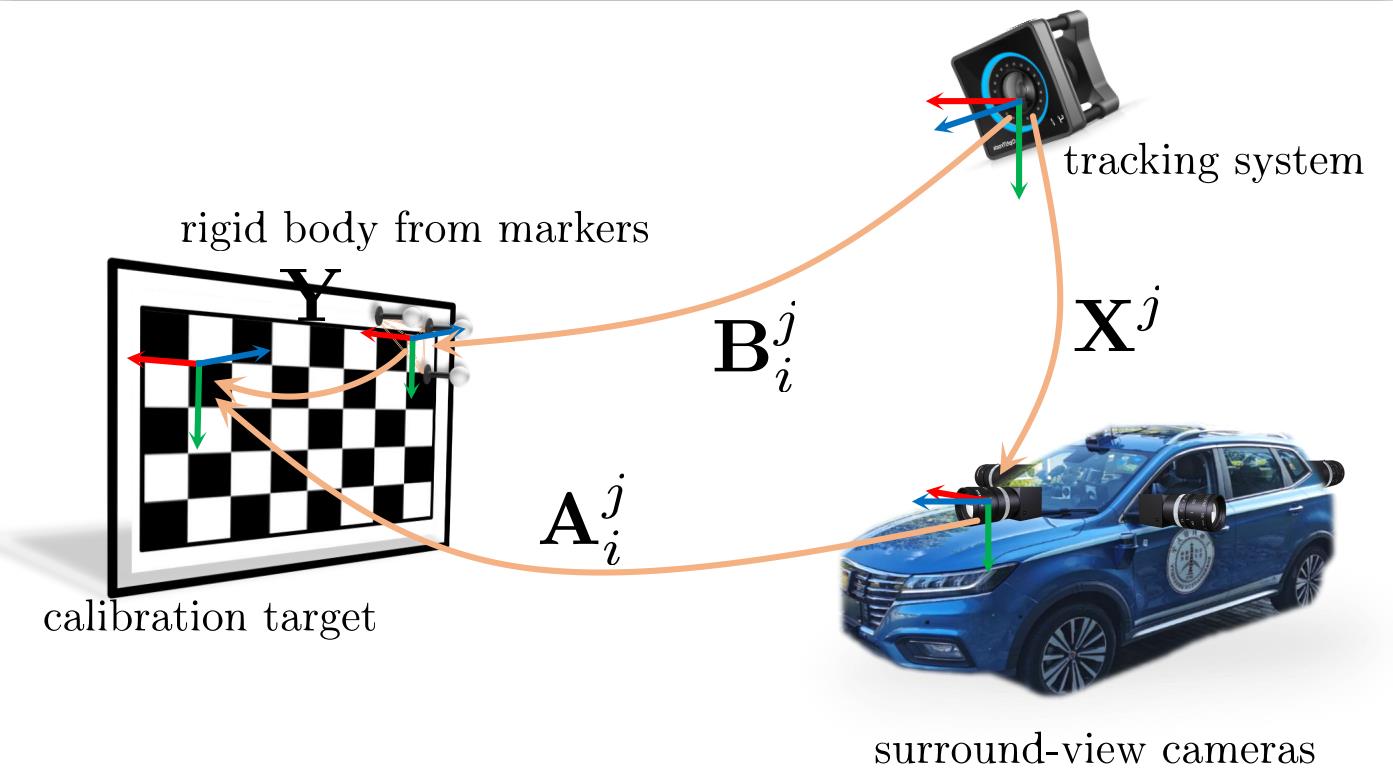
THE RESEARCH QUESTION
How can a non-overlapping camera rig be calibrated to a tracking system?
A rig with many viewpoints does not necessarily share a common field of view. Extending conventional single-camera hand–eye calibration requires a model that accounts for all camera perspectives and their relationship to the tracked base. [Paper]
How the method works
- A generalized multi-eye-to-base constraint relates camera observations to externally measured motion.
- The formulation yields a closed-form calibration solution and connects to the equivalent multi-eye-in-hand configuration.
RESEARCH INTERPRETATION
What this contribution means
The result makes calibration tractable for larger multi-perspective systems, including cameras with non-overlapping views. The paper compares accuracy and efficiency with other closed-form approaches.
This section explains the contribution in context. For experimental protocols, numerical results and comparisons, consult the original paper.
Scope and limitations
The setup uses external motion information and requires measurements that constrain the calibration. It should not be read as a claim that arbitrary rigs can be calibrated without external reference data. [Paper]
Questions about this research
Does this calibration method require all cameras to see the same scene?
It is designed for multi-perspective rigs and can address non-overlapping camera configurations through the generalized calibration constraint.
Read the original abstract
Multi-perspective cameras are quickly gaining importance in many applications such as smart vehicles and virtual or augmented reality. However, a large system size or absence of overlap in neighbouring fields-of-view often complicate their calibration. We present a novel solution which relies on the availability of an external motion capture system. Our core contribution consists of an extension to the hand-eye calibration problem which jointly solves multi-eye-to-base problems in closed form. We furthermore demonstrate its equivalence to the multi-eye-in-hand problem. The practical validity of our approach is supported by our experiments, indicating that the method is highly efficient and accurate, and outperforms existing closed-form alternatives.
Original publication record ↗Sources, paper & code
Primary research sources support the summary above. Project resources provide demonstrations or implementations; Google Scholar is a bibliographic index.
- Primary sourcearXiv — paper record and versions ↗arxiv.org
- Primary sourceFull paper — author-hosted PDF ↗1fwang.github.io
- Metadata indexGoogle Scholar — bibliographic listing ↗scholar.google.com