3D scenes & avatars
StoryBlender: Inter-shot consistent and editable 3D storyboard with spatial-temporal dynamics
ECCV 2026, 130–147 · 2026
RESEARCH SUMMARY
StoryBlender turns a story into editable 3D storyboards while keeping characters, assets and spatial relationships consistent across shots. A persistent scene representation connects narrative planning with engine-verified scene construction.
Read the supporting paper ↗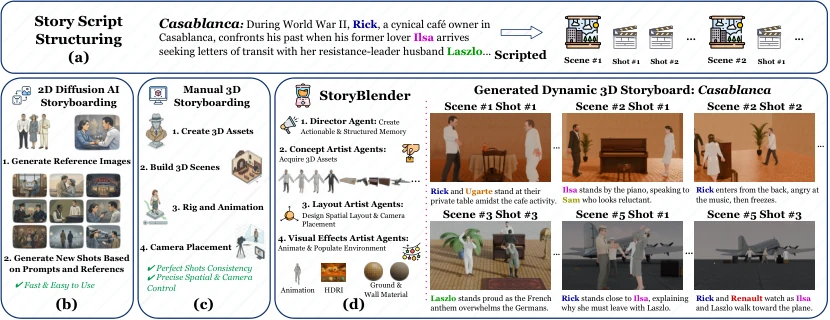
THE RESEARCH QUESTION
How can AI storyboards stay consistent across camera cuts?
Generating each shot independently can change a character's appearance, move objects or break the geography of a scene. Storyboarding also needs editable cameras and staging, so visual similarity alone is insufficient. StoryBlender treats continuity as a shared scene-management problem. [Paper]
How the method works
- A continuity memory graph separates persistent assets from the variables that change between shots, giving the sequence a shared reference.
- Canonical assets occupy a unified coordinate system. Spatial-temporal dynamics describe how cameras, objects and staging evolve through the story.
- Hierarchical agents use a Story-centric Reflection loop with engine feedback to revise scene construction. The result is a native 3D storyboard with editable assets and cameras.
RESEARCH INTERPRETATION
What this contribution means
The contribution is a connection between narrative continuity and explicit, editable spatial state. For previsualization, this makes a camera change or staging revision a scene edit rather than a request to regenerate unrelated images. The paper's comparisons examine consistency and editability; they should be read alongside its qualitative examples.
This section explains the contribution in context. For experimental protocols, numerical results and comparisons, consult the original paper.
Scope and limitations
Visual quality and style remain bounded by the underlying image-to-3D models and renderer. Repeated agent and engine checks add overhead. Bounding-box reasoning and retargeted motion primarily support broad staging, rather than detailed grasping, cloth interaction or facial animation. [Paper]
Questions about this research
Does StoryBlender produce editable 3D scenes?
Yes. Its output includes native 3D scene content and camera configurations, enabling changes to staging and viewpoints after generation.
How does it differ from generating separate storyboard images?
It maintains persistent assets and spatial relationships across shots. Separate image generation does not, by itself, provide that shared editable scene state.
Sources, paper & code
Primary research sources support the summary above. Project resources provide demonstrations or implementations; Google Scholar is a bibliographic index.
- Primary sourcePublisher — original publication record ↗link.springer.com
- Primary sourceFull paper — PDF ↗arxiv.org
- PreprintarXiv — preprint and version history ↗arxiv.org
- Research resourceProject — demos and resources ↗engineeringai-lab.github.io
- Metadata indexGoogle Scholar — bibliographic listing ↗scholar.google.com