Event-based vision
DEVO: Depth-Event Camera Visual Odometry in Challenging Conditions
2022 IEEE International conference on robotics and automation (ICRA) · 2022
RESEARCH SUMMARY
DEVO combines a depth camera with an event camera for visual odometry, aligning semidense geometry with event-derived time surfaces to track motion in challenging lighting and fast movement.
Read the supporting paper ↗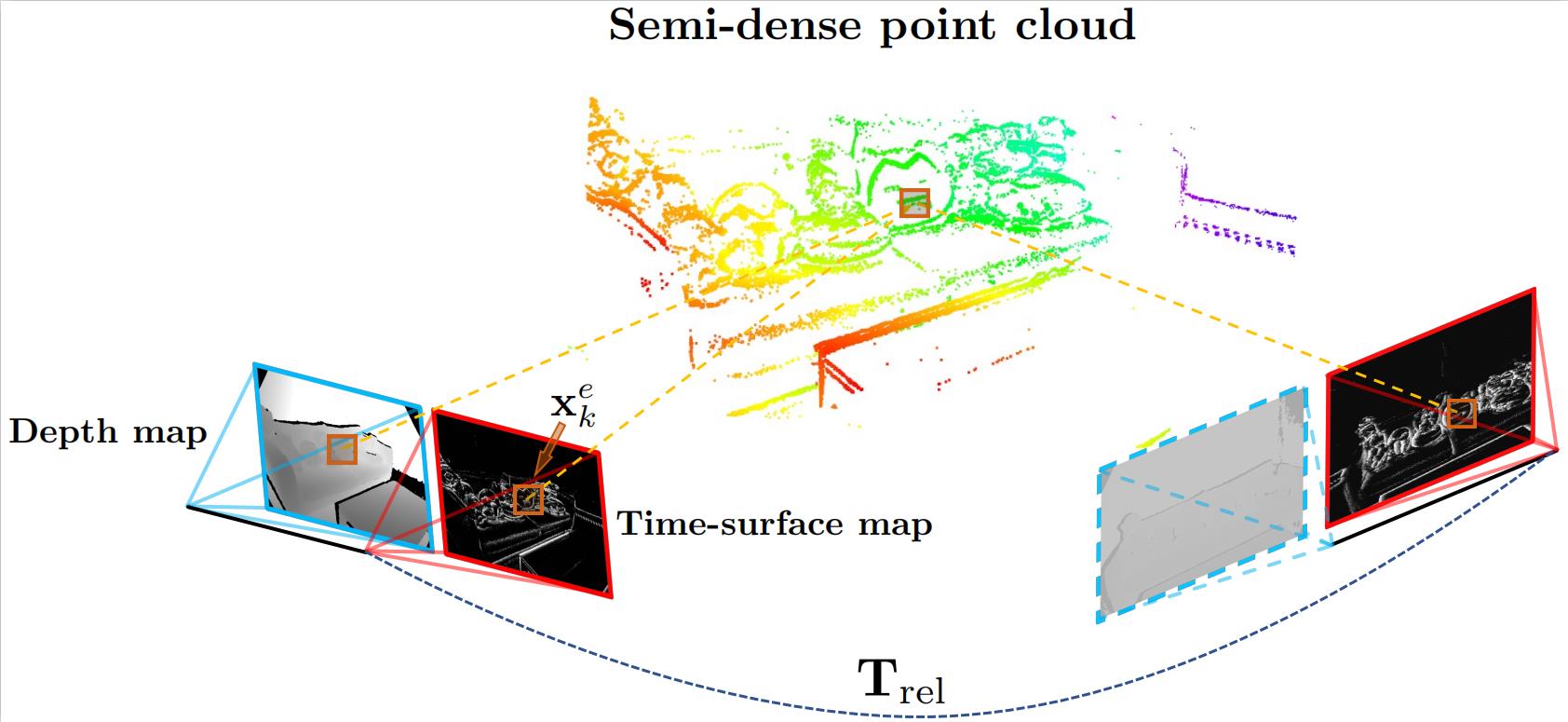
THE RESEARCH QUESTION
How do depth measurements complement an event camera?
Events capture rapid brightness changes but do not directly provide scene depth. A depth sensor supplies geometry that can support motion estimation when ordinary image tracking becomes difficult. [Paper]
How the method works
- A calibrated depth–event camera setup associates depth geometry with the event view.
- Semidense 3D-to-2D edge alignment compares warped geometry with event time surfaces to estimate motion.
RESEARCH INTERPRETATION
What this contribution means
The sensor pairing separates geometric measurement from high-temporal-resolution tracking. The paper evaluates real-time odometry on public and collected sequences, including conditions with fast motion or difficult illumination.
This section explains the contribution in context. For experimental protocols, numerical results and comparisons, consult the original paper.
Scope and limitations
The method depends on valid depth observations and accurate calibration between sensors. Improvements under the tested challenging conditions do not imply that depth sensing succeeds on every material or at every range. [Paper]
Questions about this research
Is DEVO an event-only odometry method?
No. It uses a depth–event sensor combination, with depth providing geometry for event-based alignment.
Read the original abstract
We present a novel real-time visual odometry framework for a stereo setup of a depth and high-resolution event camera. Our framework balances accuracy and robustness against computational efficiency towards strong performance in challenging scenarios. We extend conventional edge-based semi-dense visual odometry towards time-surface maps obtained from event streams. Semi-dense depth maps are generated by warping the corresponding depth values of the extrinsically calibrated depth camera. The tracking module updates the camera pose through efficient, geometric semi-dense 3D-2D edge alignment. Our approach is validated on both public and self-collected datasets captured under various conditions. We show that the proposed method performs comparable to state-of-the-art RGB-D camera-based alternatives in regular conditions, and eventually outperforms in challenging conditions such as high dynamics or low illumination.
Original publication record ↗Sources, paper & code
Primary research sources support the summary above. Project resources provide demonstrations or implementations; Google Scholar is a bibliographic index.
- Primary sourcearXiv — paper record and versions ↗arxiv.org
- Primary sourceFull paper — author-hosted PDF ↗1fwang.github.io
- Metadata indexGoogle Scholar — bibliographic listing ↗scholar.google.com