Event-based vision
Cross-modal semidense 6-DoF tracking of an event camera in challenging conditions
IEEE Transactions on Robotics, 40, 1600–1616 · 2024
RESEARCH SUMMARY
This work tracks an event camera in six degrees of freedom against a map built using another sensing modality, combining semidense geometric alignment with polarity-aware event representations.
Read the supporting paper ↗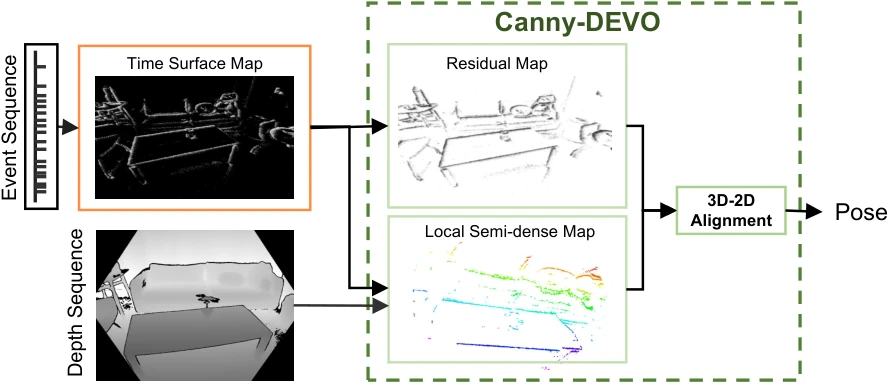
THE RESEARCH QUESTION
Can an event camera localize against a map built from ordinary images?
Event cameras report brightness changes rather than conventional frames. A map built by a depth sensor or an image-based reconstruction pipeline therefore has a different appearance representation, even when it describes the same geometry. [Paper]
How the method works
- Semidense 3D map edges are aligned with a polarity-aware spatio-temporal event representation to estimate camera motion.
- Occluded map points are culled so that geometry hidden in the current view does not distort the alignment.
RESEARCH INTERPRETATION
What this contribution means
Separating map creation from event-based tracking allows complementary sensors to contribute different strengths. The contribution is cross-modal 6-DoF localization against existing geometry, rather than requiring an event camera to reconstruct the entire map itself.
This section explains the contribution in context. For experimental protocols, numerical results and comparisons, consult the original paper.
Scope and limitations
The tracker depends on a suitable prior map and meaningful visible edge structure. Large map changes, poor geometry or insufficient event evidence can undermine alignment. [Paper]
Questions about this research
Does the event camera build the map in this method?
The tracking method can use geometry supplied by another modality, such as depth sensing or image-based reconstruction.
Sources, paper & code
Primary research sources support the summary above. Project resources provide demonstrations or implementations; Google Scholar is a bibliographic index.
- Primary sourcearXiv — paper record and versions ↗arxiv.org
- Primary sourceFull paper — PDF ↗arxiv.org
- Metadata indexGoogle Scholar — bibliographic listing ↗scholar.google.com