Event-based vision
Cross-modal place recognition in image databases using event-based sensors
arXiv:2307.01047 · Preprint · 2023
RESEARCH SUMMARY
This work recognizes places from event-camera observations by retrieving matches in a conventional image database, connecting event sensing with existing visual reference maps.
Read the supporting paper ↗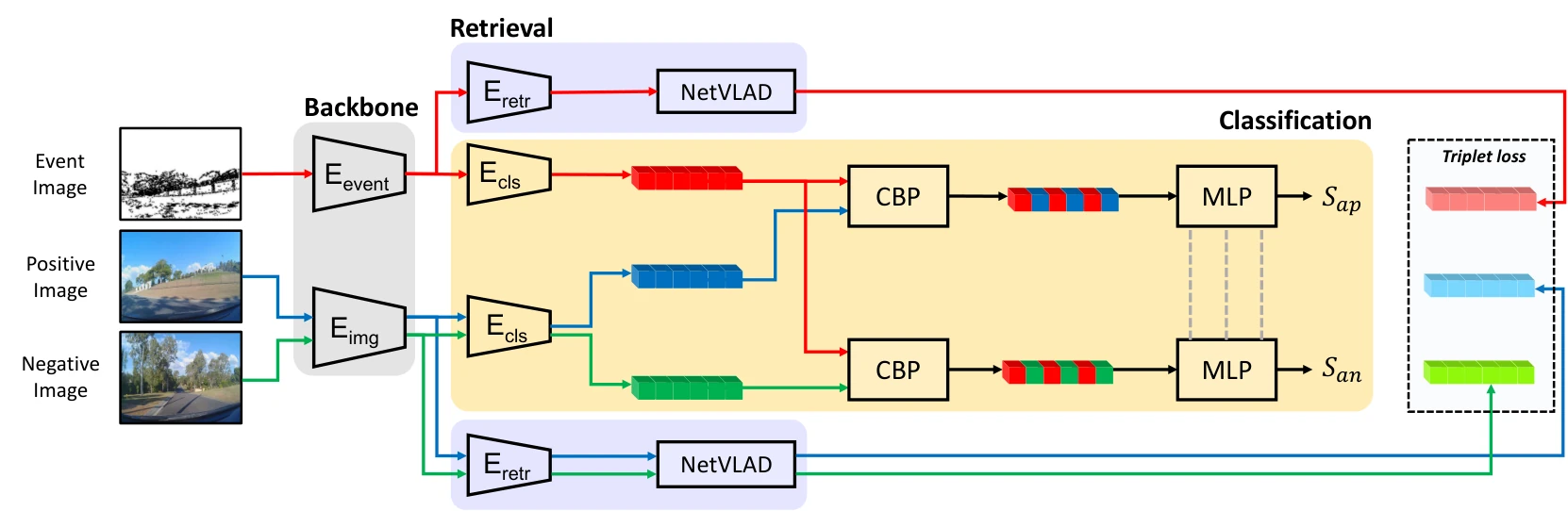
THE RESEARCH QUESTION
Can an event-based query find a location in an RGB image database?
Many reference maps contain ordinary images, while a robot may use an event camera in challenging lighting. The mismatch between these representations makes direct appearance matching difficult. [Paper]
How the method works
- The method combines retrieval and classification objectives to connect event-derived observations with image-based place representations.
- Experiments on Brisbane-Event-VPR study cross-modal place recognition under changing illumination.
RESEARCH INTERPRETATION
What this contribution means
Reusing an image database could reduce the need to remap every place with an event sensor. The output identifies a likely location or reference observation, which can support a later localization stage.
This section explains the contribution in context. For experimental protocols, numerical results and comparisons, consult the original paper.
Scope and limitations
Place retrieval is not a continuous six-degree-of-freedom pose estimate. Performance depends on database coverage and the visual conditions represented during evaluation. [Paper]
Questions about this research
Does this method estimate a full camera trajectory?
Its focus is place recognition: matching an event query to an image database. Continuous geometric tracking is a separate task.
Sources, paper & code
Primary research sources support the summary above. Project resources provide demonstrations or implementations; Google Scholar is a bibliographic index.
- Primary sourcearXiv — paper record and versions ↗arxiv.org
- Primary sourceFull paper — PDF ↗arxiv.org
- Metadata indexGoogle Scholar — bibliographic listing ↗scholar.google.com