Event-based vision
Revisiting event-based video frame interpolation
IROS 2023 · 2023
RESEARCH SUMMARY
This paper combines RGB-guided motion estimation with event-based refinement for video frame interpolation, using incremental intermediate-frame synthesis to handle larger temporal gaps.
Read the supporting paper ↗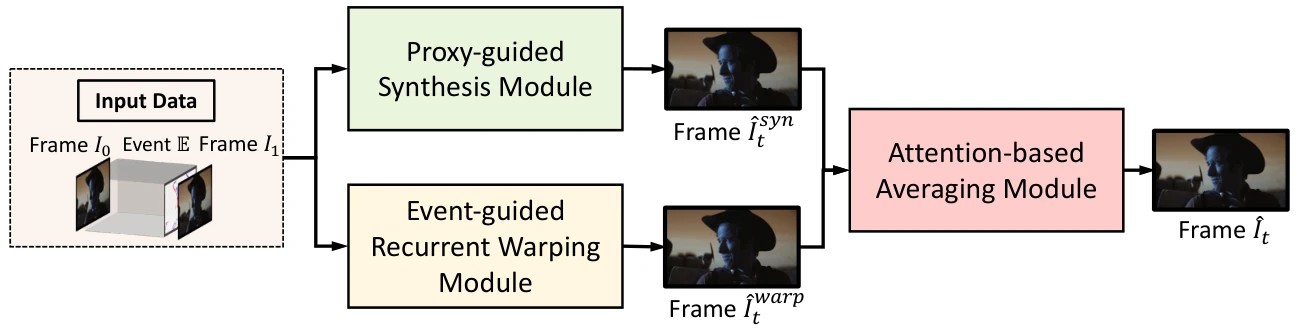
THE RESEARCH QUESTION
How do event measurements help reconstruct frames between RGB images?
Conventional frames leave motion unobserved between exposures. Events provide precise timing of brightness changes, but do not directly contain full color images. The two modalities therefore supply complementary evidence for interpolation. [Paper]
How the method works
- RGB information guides the initial motion estimate, while events refine motion using their high temporal resolution.
- An incremental, divide-and-conquer interpolation strategy constructs intermediate frames rather than solving every long interval in one step.
RESEARCH INTERPRETATION
What this contribution means
The study emphasizes how to combine the modalities, rather than assuming that adding events automatically improves interpolation. Synthetic and real-data evaluations examine the resulting image reconstruction.
This section explains the contribution in context. For experimental protocols, numerical results and comparisons, consult the original paper.
Scope and limitations
This is interpolation between observed frames using sensor evidence. It is distinct from text-to-video generation or predicting an unseen future; input quality and the motion within the observed interval remain important. [Paper]
Questions about this research
Can events replace RGB information entirely for this task?
The described method uses both. Events contribute motion timing, while RGB frames supply appearance information.
Sources, paper & code
Primary research sources support the summary above. Project resources provide demonstrations or implementations; Google Scholar is a bibliographic index.
- Primary sourcearXiv — paper record and versions ↗arxiv.org
- Primary sourceFull paper — PDF ↗arxiv.org
- Research resourceProject — demos and resources ↗jiabenchen.github.io
- Metadata indexGoogle Scholar — bibliographic listing ↗scholar.google.com