Event-based vision
Dynamic Event Camera Calibration
2021 IEEE/RSJ International Conference on Intelligent Robots and Systems (IROS) · 2021
RESEARCH SUMMARY
Dynamic Event Camera Calibration uses motion between an event camera and a conventional calibration pattern to estimate camera parameters, followed by continuous-time refinement.
Read the supporting paper ↗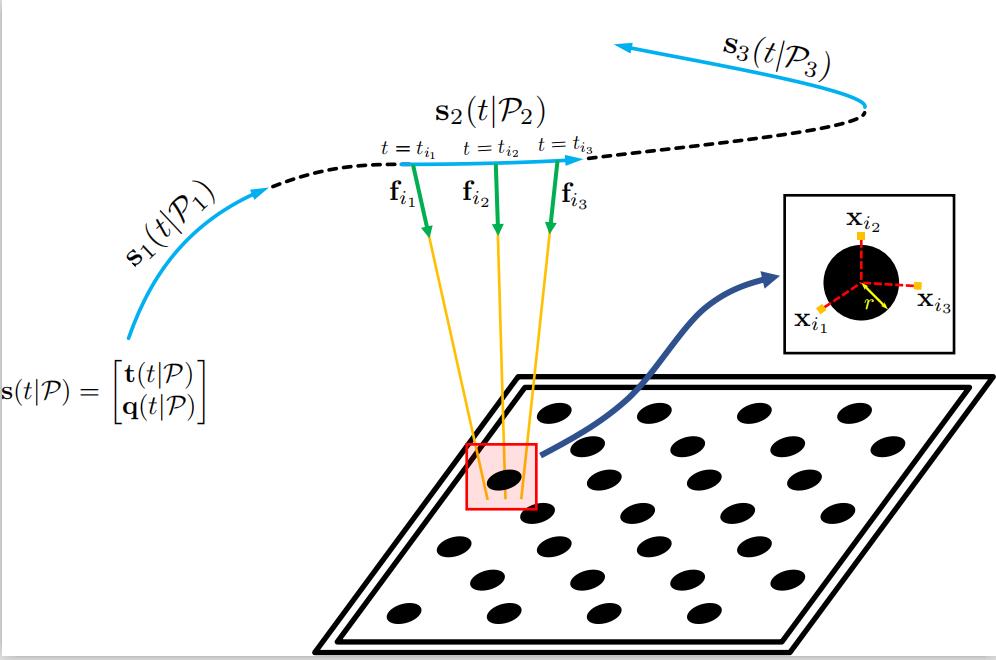
THE RESEARCH QUESTION
How can an event camera observe a standard calibration target?
An event camera responds to brightness changes, so a stationary camera looking at a stationary board produces little useful evidence. Calibration must account for how motion creates event observations. [Paper]
How the method works
- Relative motion makes the ordinary calibration pattern visible in the event stream, from which target features are extracted.
- Conventional initialization is followed by multi-segment continuous-time refinement of the calibration estimate.
RESEARCH INTERPRETATION
What this contribution means
The approach makes ordinary calibration patterns useful for event sensing through a motion-aware estimation process. It connects asynchronous observations to familiar camera calibration geometry.
This section explains the contribution in context. For experimental protocols, numerical results and comparisons, consult the original paper.
Scope and limitations
Successful calibration requires suitable motion and observable target features. The continuous-time treatment addresses event timing; it does not remove the need for well-conditioned calibration data. [Paper]
Questions about this research
Why is motion necessary for this calibration procedure?
Events are triggered by brightness changes. Moving the camera or target creates the measurements needed to observe the pattern.
Read the original abstract
Camera calibration is an important prerequisite towards the solution of 3D computer vision problems. Traditional methods rely on static images of a calibration pattern. This raises interesting challenges towards the practical usage of event cameras, which notably require image change to produce sufficient measurements. The current standard for event camera calibration therefore consists of using flashing patterns. They have the advantage of simultaneously triggering events in all reprojected pattern feature locations, but it is difficult to construct or use such patterns in the field. We present the first dynamic event camera calibration algorithm. It calibrates directly from events captured during relative motion between camera and calibration pattern. The method is propelled by a novel feature extraction mechanism for calibration patterns, and leverages existing calibration tools before optimizing all parameters through a multi-segment continuous-time formulation. As demonstrated through our results on real data, the obtained calibration method is highly convenient and reliably calibrates from data sequences spanning less than 10 seconds.
Original publication record ↗Sources, paper & code
Primary research sources support the summary above. Project resources provide demonstrations or implementations; Google Scholar is a bibliographic index.
- Primary sourcePublisher — original publication record ↗ieeexplore.ieee.org
- Primary sourceFull paper — author-hosted PDF ↗1fwang.github.io
- Metadata indexGoogle Scholar — bibliographic listing ↗scholar.google.com