Geometry & SLAM
ColonAdapter: Geometry Estimation Through Foundation Model Adaptation for Colonoscopy
IEEE Robotics and Automation Letters · 2025
RESEARCH SUMMARY
ColonAdapter adapts a visual geometry foundation model to colonoscopy, using self-supervised geometric and photometric constraints to estimate depth, camera pose and dense 3D structure.
Read the supporting paper ↗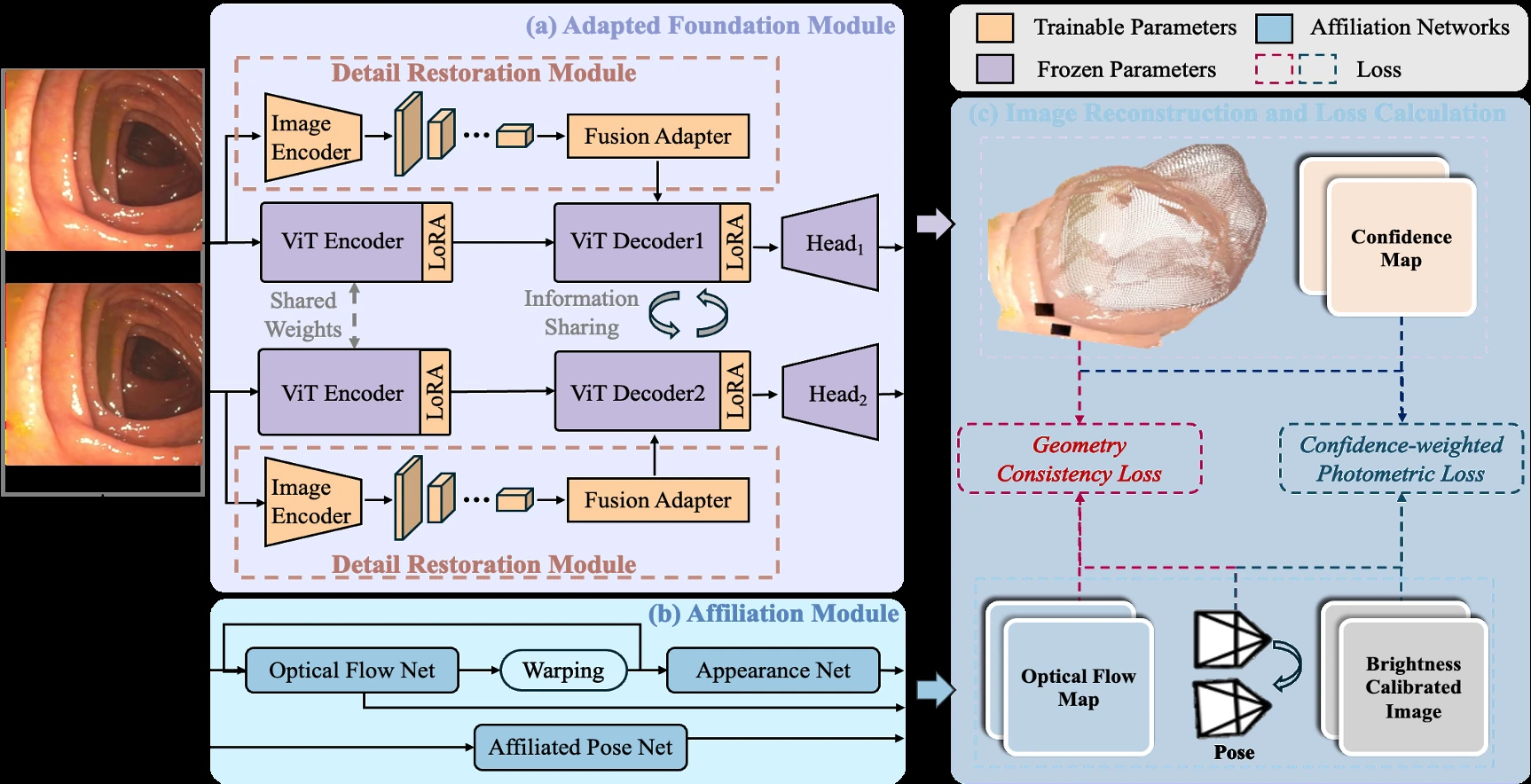
THE RESEARCH QUESTION
Why does a general geometry model need adaptation for colonoscopy?
Colonoscopy images differ from ordinary photographs: surfaces have limited texture, illumination moves with the camera and specular reflections change with viewpoint. These properties create a domain gap for geometry models trained on natural scenes. [Paper]
How the method works
- The method adapts a DUSt3R-based geometry model with a self-supervised training design suited to colonoscopy imagery.
- A DRM module, geometric consistency and confidence-weighted photometric losses guide adaptation while handling unreliable visual evidence.
RESEARCH INTERPRETATION
What this contribution means
The work studies whether pretrained geometric knowledge can transfer to a specialized imaging domain with suitable supervision. Synthetic and real-data experiments assess geometric estimation, including operation without ground-truth camera intrinsics.
This section explains the contribution in context. For experimental protocols, numerical results and comparisons, consult the original paper.
Scope and limitations
The contribution concerns geometry estimation. Its experiments should not be interpreted as validation of disease diagnosis or of an autonomous clinical procedure. Performance remains tied to the imaging conditions and evaluation data in the paper. [Paper]
Questions about this research
What does ColonAdapter estimate?
It targets camera pose, depth and dense 3D geometry from colonoscopy imagery.
Sources, paper & code
Primary research sources support the summary above. Project resources provide demonstrations or implementations; Google Scholar is a bibliographic index.
- Primary sourcePublisher — original publication record ↗ieeexplore.ieee.org
- Primary sourceFull paper — PDF ↗arxiv.org
- PreprintarXiv — preprint and version history ↗arxiv.org
- Metadata indexGoogle Scholar — bibliographic listing ↗scholar.google.com