3D scenes & avatars
3DXTalker: Unifying Identity, Lip Sync, Emotion, and Spatial Dynamics in Expressive 3D Talking Avatars
arXiv:2602.10516 · Preprint · 2026
RESEARCH SUMMARY
3DXTalker combines identity, audio-driven lip motion, emotion and head-pose control in expressive 3D talking avatars. Its representation separates these factors so that speech animation and semantic control can work together.
Read the supporting paper ↗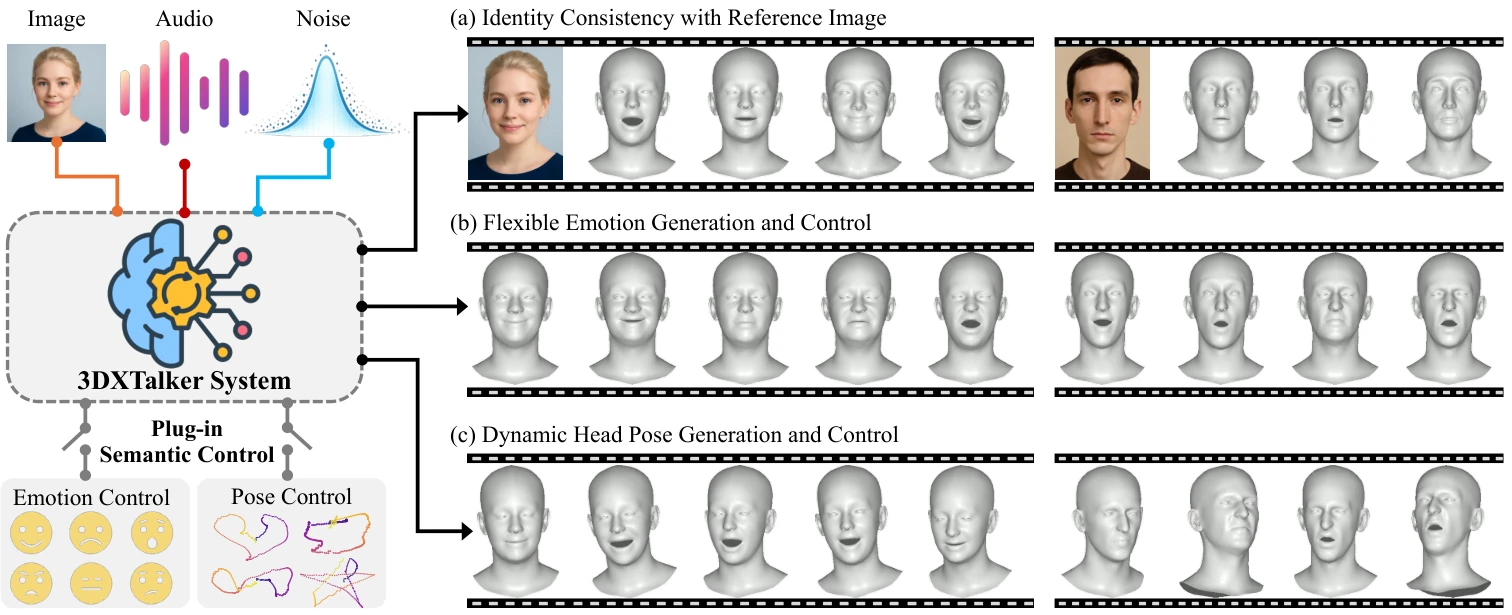
THE RESEARCH QUESTION
How can a talking avatar preserve identity while changing expression and pose?
Matching mouth movement to speech is only part of an expressive avatar. Identity should remain stable while facial emotion and head motion change. Entangling those factors makes targeted control difficult and can reduce consistency. [Paper]
How the method works
- A scalable 2D-to-3D data-curation pipeline supplies facial animation parameters, with identity represented separately from time-varying motion.
- A flow-matching transformer models motion using audio features that capture more than phonetic timing, including amplitude and emotional cues.
- Decoupled semantic conditioning provides emotion and pose control alongside audio-driven lip synchronization.
RESEARCH INTERPRETATION
What this contribution means
The research brings several avatar controls into a common 3D animation framework. Its practical value is the possibility of changing delivery or head motion without rebuilding a person's identity representation. This is an animation contribution, rather than a claim that audio uniquely determines a speaker's true emotions.
This section explains the contribution in context. For experimental protocols, numerical results and comparisons, consult the original paper.
Scope and limitations
The quality of 3D supervision is bounded by the upstream EMOCA reconstruction process. Filtering and smoothing can reduce some errors but cannot remove every reconstruction artifact. Dataset and language diversity also affect generalization to new expressions and speech. [Paper]
Questions about this research
Is 3DXTalker only a lip-sync model?
No. It jointly addresses identity, lip synchronization, emotion and spatial head dynamics in a 3D avatar representation.
Can emotion and head pose be controlled separately?
The method includes decoupled semantic control for emotion and pose, alongside audio conditioning. The paper provides the experimental scope of those controls.
Sources, paper & code
Primary research sources support the summary above. Project resources provide demonstrations or implementations; Google Scholar is a bibliographic index.
- Primary sourcearXiv — paper record and versions ↗arxiv.org
- Primary sourceFull paper — PDF ↗arxiv.org
- Metadata indexGoogle Scholar — bibliographic listing ↗scholar.google.com