Event-based vision
Globally-Optimal Contrast Maximisation for Event Cameras
IEEE Transactions on Pattern Analysis and Machine Intelligence · 2021
RESEARCH SUMMARY
This paper develops globally optimal contrast maximization for event-camera motion models, using branch-and-bound search with recursive bounds to avoid dependence on a favorable initial guess.
Read the supporting paper ↗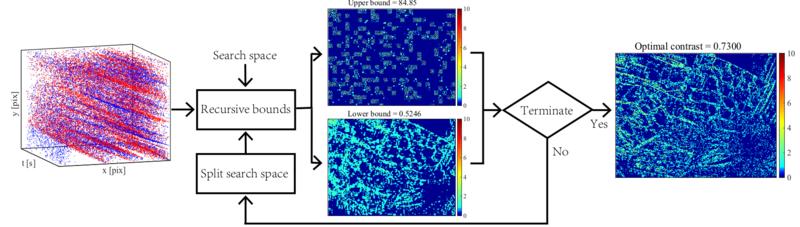
THE RESEARCH QUESTION
Can event contrast maximization avoid local optima?
Warping events with the correct motion tends to sharpen their accumulated representation. However, the contrast objective is nonconvex, so local optimization can converge to an incorrect solution. [Paper]
How the method works
- Branch-and-bound partitions the allowed motion-parameter space and compares provable upper and lower objective bounds.
- Recursive bounds support six contrast functions and the motion-estimation problems studied in the paper.
RESEARCH INTERPRETATION
What this contribution means
The contribution changes the optimization guarantee for the formulated contrast objective. It provides a way to reason about the best solution within a model and search domain, rather than accepting the result of a local optimizer.
This section explains the contribution in context. For experimental protocols, numerical results and comparisons, consult the original paper.
Scope and limitations
Global optimality applies to the stated objective, motion model and search domain. It does not mean every physical scene satisfies that model, nor does it establish real-time performance for arbitrary configurations. [Paper]
Questions about this research
Does globally optimal mean the estimated motion is always physically correct?
No. It means the optimization finds the global optimum of its specified objective under its assumptions. Model mismatch and measurement quality remain relevant.
Read the original abstract
Event cameras are bio-inspired sensors that perform well in challenging illumination conditions and have high temporal resolution. However, their concept is fundamentally different from traditional frame-based cameras. The pixels of an event camera operate independently and asynchronously. They measure changes of the logarithmic brightness and return them in the highly discretised form of time-stamped events indicating a relative change of a certain quantity since the last event. New models and algorithms are needed to process this kind of measurements. The present work looks at several motion estimation problems with event cameras. The flow of the events is modelled by a general homographic warping in a space-time volume, and the objective is formulated as a maximisation of contrast within the image of warped events. Our core contribution consists of deriving globally optimal solutions to these generally non-convex problems, which removes the dependency on a good initial guess plaguing existing methods. Our methods rely on branch-and-bound optimisation and employ novel and efficient, recursive upper and lower bounds derived for six different contrast estimation functions. The practical validity of our approach is demonstrated by a successful application to three different event camera motion estimation problems.
Original publication record ↗Sources, paper & code
Primary research sources support the summary above. Project resources provide demonstrations or implementations; Google Scholar is a bibliographic index.
- Primary sourcePublisher — original publication record ↗ieeexplore.ieee.org
- Primary sourceFull paper — author-hosted PDF ↗1fwang.github.io
- Metadata indexGoogle Scholar — bibliographic listing ↗scholar.google.com