Event-based vision
Globally-Optimal Event Camera Motion Estimation
European Conference on Computer Vision · 2020
RESEARCH SUMMARY
This work derives a globally optimal contrast-maximization solution for event-camera motion estimation, focusing on the fronto-parallel geometry of a downward-looking ground-vehicle camera.
Read the supporting paper ↗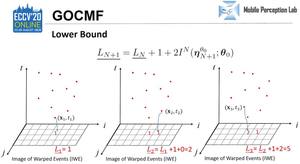
THE RESEARCH QUESTION
How can a downward-looking event camera estimate ground-vehicle motion?
Motion compensation can align ground-plane events, but optimizing alignment contrast locally can depend strongly on initialization. The paper studies a global solution within the relevant motion model. [Paper]
How the method works
- A homographic warp describes event motion under the fronto-parallel configuration.
- Branch-and-bound with bounds for six contrast functions searches for the best motion parameters without requiring an initial motion guess.
RESEARCH INTERPRETATION
What this contribution means
The restricted geometry makes a meaningful global optimization result possible. It is a foundation for the broader study of globally optimal event contrast maximization in the later journal paper.
This section explains the contribution in context. For experimental protocols, numerical results and comparisons, consult the original paper.
Scope and limitations
The camera and scene configuration are central assumptions. This result should not be generalized to unrestricted 6-DoF movement through arbitrary 3D scenes. [Paper]
Questions about this research
What camera configuration is central to this paper?
The work focuses on fronto-parallel motion, including a downward-looking event camera on an autonomous ground vehicle.
Read the original abstract
Event cameras are bio-inspired sensors that perform well in HDR conditions and have high temporal resolution. However, different from traditional frame-based cameras, event cameras measure asynchronous pixel-level brightness changes and return them in a highly discretised format, hence new algorithms are needed. The present paper looks at fronto-parallel motion estimation of an event camera. The flow of the events is modeled by a general homographic warping in a space-time volume, and the objective is formulated as a maximisation of contrast within the image of unwarped events. However, in stark contrast to prior art, we derive a globally optimal solution to this generally non-convex problem, and thus remove the dependency on a good initial guess. Our algorithm relies on branch-and-bound optimisation for which we derive novel, recursive upper and lower bounds for six different contrast estimation functions. The practical validity of our approach is supported by a highly successful application to AGV motion estimation with a downward facing event camera, a challenging scenario in which the sensor experiences fronto-parallel motion in front of noisy, fast moving textures.
Original publication record ↗Sources, paper & code
Primary research sources support the summary above. Project resources provide demonstrations or implementations; Google Scholar is a bibliographic index.
- Primary sourcePublisher — original publication record ↗link.springer.com
- Primary sourceFull paper — author-hosted PDF ↗1fwang.github.io
- Metadata indexGoogle Scholar — bibliographic listing ↗scholar.google.com