Video generation
I3DM: Implicit 3D-aware Memory Retrieval and Injection for Consistent Video Scene Generation
arXiv:2603.23413 · Preprint · 2026
RESEARCH SUMMARY
I3DM preserves scene consistency in generated video by retrieving useful historical views and injecting spatially aligned memory features, without requiring an explicit 3D reconstruction of the scene.
Read the supporting paper ↗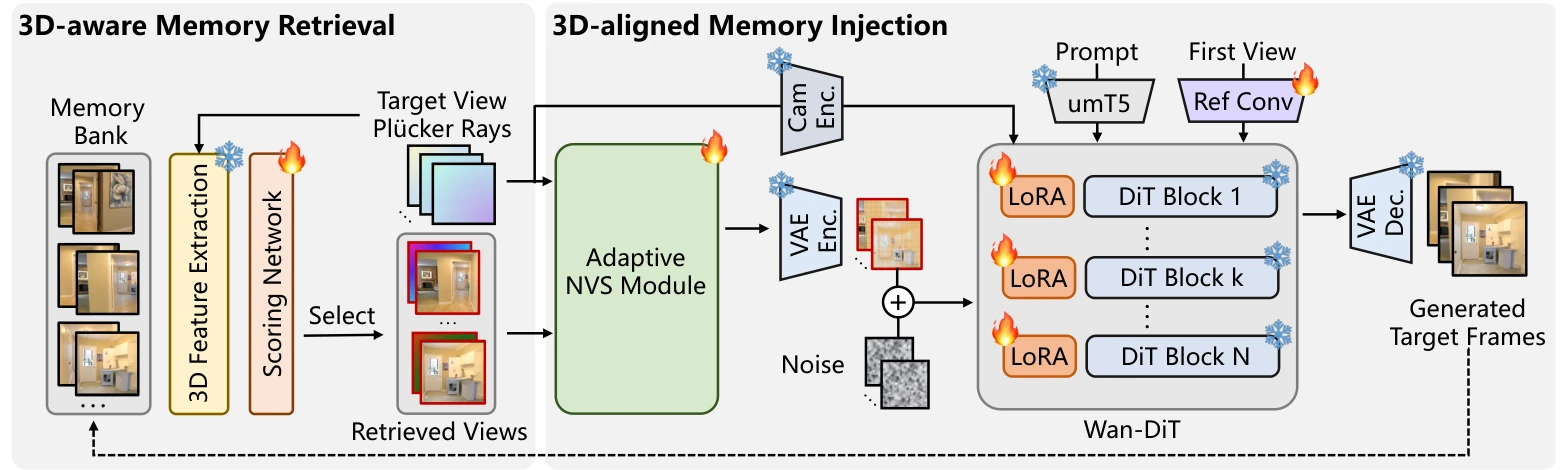
THE RESEARCH QUESTION
How can a video generator remember a scene when the camera returns?
A camera can turn away from an object and later revisit it. Short temporal context may forget that object, while selecting history only by camera field of view can overlook occlusion and whether a frame actually contains useful evidence. [Paper]
How the method works
- Intermediate features from a feed-forward novel-view-synthesis model provide implicit 3D cues for scoring the relevance of historical views.
- Selected memory features are warped toward the target view. Adaptive injection emphasizes spatially reliable regions instead of treating every historical pixel equally.
- Retrieval and injection work together to condition video generation on remembered scene content without maintaining an explicit reconstructed 3D model.
RESEARCH INTERPRETATION
What this contribution means
This approach treats memory selection as a geometric relevance problem. A large archive helps only when the generator can find and align the right evidence. Compared with explicit geometric memory, implicit features offer another way to connect earlier observations to a new camera view.
This section explains the contribution in context. For experimental protocols, numerical results and comparisons, consult the original paper.
Scope and limitations
Retrieval becomes more expensive as the memory bank grows. The paper also identifies a training–inference gap: generated history can be noisier than training history. Using earlier, cleaner frames helps but does not fully resolve that drift. [Paper]
Questions about this research
Does I3DM require an explicit 3D scene model?
No. It uses implicit 3D-aware features from novel-view synthesis for memory retrieval, warping and injection.
Why not retrieve frames only by camera overlap?
Geometric overlap alone does not account for occlusion or the quality of the visual evidence. I3DM uses learned spatial features to assess which history is useful.
Sources, paper & code
Primary research sources support the summary above. Project resources provide demonstrations or implementations; Google Scholar is a bibliographic index.
- Primary sourcearXiv — paper record and versions ↗arxiv.org
- Primary sourceFull paper — PDF ↗arxiv.org
- Metadata indexGoogle Scholar — bibliographic listing ↗scholar.google.com